cwmbwergwm
Abersychan - from Snatchwood to Cwmavon
Including The British, Lasgarn, Garndiffaith and Varteg
Abersychan at 'Industrial Monmouthshire - The Leftovers'

Including Snatchwood, Lasgarn, Cwmsychan, Garndiffaith, Golynos, Talywain and Varteg.

Click on a photo to enlarge it but if there are no return links available,
please use the 'back' button on your browser to return to this page.

ABERSYCHAN TOWN

The Abersychan (Twyn-y-ffrwd) incline ran from the MRCC tramway in Abersychan (SO 2700 0390) to Talywain (SO 2629 0403). It was a standard-gauge incline opened around 1858 and shown as 'old' by 1902 to replace the tramway which followed the route of the B4246 to The British. Most of the incline can still be followed as a public footpath or a rough track. The bottom has been lost under the main road but the incline top area is still well-defined. The line from incline top to The British crossed the LNWR on the surviving bridge (SO 2610 0423) and sidings are still shown as still in use up to 1953.

Back to the top

LASGARN

The Cwm Lasgarn quarry (SO 2820 0470) opened in 1827 at the same time as the British Ironworks to supply it with limestone, probably closing around 1854 when the Abersychan Incline opened but certainly by 1876 when pig-iron production ceased at the British. A 3'10" gauge tramway ran from the quarry around the hillside through Lasgarn woods to an incline where it dropped down to the Afon Llwyd and back up to the MRCC tramway on the other bank. The tramway continued alongside the MRCC and up to the British Ironworks along the route of the B4246.

The abutments and embankment to the MRCC on the river's West bank beside Valentine Road are well-preserved (SO 2702 0346) but only the foundations remain on the East bank. The incline is visible again at the top (SO 2729 0341) where the brake house site occupied the flattened area. The tramway meanders through the woods with many stone sleepers and a number of branches off to the East to many small workings. A stone-faced embankment (SO 2745 0384) goes round a deep hole (from quarrying?) and stream, where the original route may well have crossed straight over as there are signs of a former route. Another, shallower embankment (SO 2742 0416) crosses a lengthy depression.

At the quarry the line branches off to the North and South of the large bank of spoil, on top of which was possibly the stockpile area, with evidence of tramways. The South branch rises up just before the spoil tip to pass through a short, partially-collapsed tunnel at SO 281045, apparently to the original workings. The North branch is hidden behind a jungle of brambles and bushes but leads to a fork where it appears two tunnels went through a bank to the quarry faces. The left-hand tunnel has been buried or collapsed but the right-hand tunnel is well-preserved and open for about 12ft. Both tunnels led to a number of forks some in stone-lined cuttings, which can be followed to the quarry face. In the faces some small caves or passageways are visible. The whole area around the quarry is now very overgrown.

CWMBERGWM

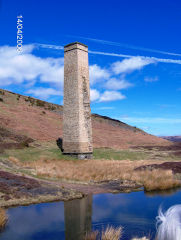
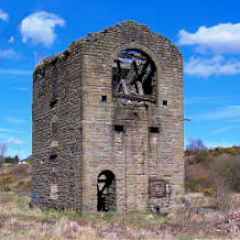
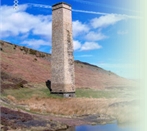
The landmark engine-house chimney marks the site of Cwmbergwm Colliery (SO 2495 0335) opened in the 1840s and finally closed around 1910 after a chequered history. The outlines of two shafts are a little to the East of the chimney and the incline from here can be followed down to the Talywain to Cwm-nant-ddu railway through SO 2524 0336. The water balance pit (SO 2521 0325) has the the sad remains of its headgear scattered about the spoil tips. The rest of the site has been quite disturbed over the years.

British Quarry (SO 2515 0365) and connected with the British by an incline which can best be seen at SO 2535 0365 where there is a stone-built 'subway' (as it's described on the OS map) underneath it.

Back to the top

CWMSYCHAN

Cwmsychan Red Ash Colliery (SO 2491 0436) was also known as 'Abertillery and Tal-y-waun Collieries' (on 1902 OS map). There are two surviving buildings and some very interesting but unidentified foundations on the site. The colliery reservoir (SO 2490 0446) is fenced off but almost empty behind the buildings. The tramways leading to and from the colliery can easily be traced. From the colliery one tramway runs West up the valley for nearly 1 mile to a substantial dam, passing three levels to the North on its way. The level nearest the colliery (SO 2480 0437) appears to have worked between the 1st and 2nd World Wars and the site is clearly visible. The two nearer the reservoir are less clear and are marked as 'old' on the 1922 map but don't appear on earlier editions. There are also signs of another level beyond and below the ruins of Ty Cwmsychan.

The massive stone-built dam (SO 2443 0413) was built before 1880 to serve the British Ironworks, probably dating back to the start of the ironworks in the 1830s, using stone from the quarry on its South bank. It is marked as disused by 1953 but is still an impressive site and a very solidly built structure. The overflow is open at the North side and can be explored but mind the smell and the dead sheep!!

Back to the top

CWM FFRWD

The Cwm Ffrwd valley was the home of John Vipond's Lower Varteg Colliery, a long-lived complex of mines, which have been landscaped out of recognition. However, the 1899 adit has been restored with a couple of drams in front. It can be found at SO 2558 0493 but is rather hidden and out of context in a dip in the ground. The filled-in girder bridge that takes the lane over the colliery branchline is at SO 2572 0473.

Further up the valley there was a long stone-built culvert under the spoil tips (SO 2508 0537). This has partly collapsed but the lower end contains iron hoop reinforcements.

Graig Wen Colliery (SO 2485 0521) was a modern small mine above the South side of the valley. It opened in 1980 and had closed by 1998. Both adits remain along with the overgrown double track tramway between them.

Back to the top

VARTEG HILL and VILLAGE

Varteg was the other centre of John Vipond's operations, based around the 3 mile long branch from the LNWR at Blaenavon Junction to Varteg Hill Colliery. The trackbed is now a well-established track and can be easily followed from the Varteg Road. The reservoir of the Pontypool Gas and Water Co, opened by 1902, is the first site to be met on the right (SO 2629 0681).

On the left is the head of Viponds incline (SO 2617 0640) which can be followed down to the information point on the Varteg Road. 100 yards down the incline is cut by the first stage of the NCB zig-zag railway to Talywain. A little further along in a dip is the green corrugated adit shed of Cwm Glo Collierywhich was active from 1992 to 1997 (SO 2616 0628). Until 2008 the haulage engine and compressor building was still standing but has now gone. The screens, loading dock, rails and safety brake can be found but the site is slowly being stripped.

The area known as 'The Lighthouse' on the left (SO 2606 0621) has foundations, pits and walls, with extensive tips on the right. these are the remains of the washery and engine sheds that served the many mines in the area. To the North were Mine Slope, New Slope and Waun Hoskins Slope, all buried by opencast workings. A small reservoir and the earthworks of a ventilating fan with a short but solid incline embankment below it have survived. (SO 2557 0678). In the field to the South of The Lighthouse a substantial stone wall exists with a large iron reinforcing plate. In 2008 this was behind an old caravan at SO 2627 0578.

The site of Bracey's Pit (SO 2592 0584) is on the right as the line curves round to head across country towards Top Pits. Braceys (or Bracys) Pit was shown as disused by 1886. The line heads across a high embankment with the slight remains of old levels and tramways on the right across the dip. A curious relic is embedded in the ground about 50yds off to the left when the line regains, a 2inch thick wire cable, haulage rope or what? very roughly at SO 2524 0600.

Old sleepers appear in the trackbed as the two remaining buildings of Varteg Top Pits loom closer. Part of the stone-built engine house and a newer brick-build building remain in agricultural use (SO 2453 0629). A small reservoir and the base of another building are to their left. In front of them are the ruins of the loading area and the top of a filled-in shaft, now a mound but still a depression in 2008. A little further on, behind the spoil tip are the brick magazine and an older, ruined stone magazine. There's little but earthworks to see at the site of Red Ash Colliery (SO 2400 0632) and Graig-Ddu Quarry (SO 2404 0660).
Gladstone Terrace engine house SO 2668 0566 The foundations of what appears to be the engine house for a very old level or colliery.
LNWR Varteg Station SO 2683 0603 The iron bridge carries the footpath over the railway trackbed which provided access to the station. The platform is on the Western side and there are the ruins of part of the station buildings.
Shop Lane overbridge SO 2674 0623 An intricate and sloping iron bridge carries Shop Lane over the LNWR.
Varteg Incline overbridge SO 2669 0640 The stone abutments of the bridge over the LNWR carrying the Varteg Incline down to GWR.


Back to the top

CWMAVON

Gallowsgreen Quarry SO 2665 0690 A surprisingly deep and extensive quarry to the West of the LNWR is accessed by an iron underbridge.
Gomers Castle Quarry
Gomers Castle Inn
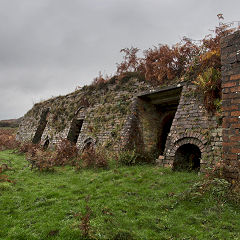
SO 2660 0706 A small quarry to the West of the LNWR and closed by 1901 was accessed by a partly-filled iron underbridge. There is a very large and substantially-built limekiln here, complete with the remains of the brick chimney. A short incline, shown as rail-less in 1882, runs down to the GWR next to the old Gomers Castle Inn which was open until at least the 1920s.
Cwmavon reservoir SO 2688 0710 Cwmavon reservoir is still in use.


Photo Gallery

Many more photos of the Abersychan area are in the photo galleries :-

From Snatchwood to Cwmavon via Lasgarn, Cwmbergwm, Cwmsychan, The British and Garndiffaith - The Abersychan Gallery.

Varteg Hill, Colliery and Village - The Varteg Gallery.


Other Locations

A comprehensive sortable 'Excel' spreadsheet of all known sites can be downloaded here :- The Industrial Archaeology of Monmouthshire

Back to the top


All rights reserved - Phil jenkins