|
Pontypool at 'Industrial Monmouthshire - The Leftovers'
Including Panteg and Griffithstown, Pontypool and Pontymoile, Blaendare, Upper and Lower Race, The Glyn Valley, Hafodyrynys, Pontnewynydd, Tirpentws and Cwm-ffrwd-oer and
Blaenserchan and Cwm-nant-ddu.
Click on a photo to enlarge it but if there are no return links available,
please use the 'back' button on your browser to return to this page.
PANTEG and GRIFFITHSTOWN
County Hospital, Griffithstown
|
A narrow-gauge tramway ran from a siding on the MRCC railway to deliver coal to the hospital boiler house. It crossed the Monmouthshire Canal
to the hospital grounds on what appears to be simply a couple of girders on concrete abutments. The girders have gone but the abutments remain at ST 292995.
|
Panteg (Pontypool) Gasworks
|
The second gasworks in Pontypool opened in 1946 on a large site at ST 296998, right beside Pontypool Road loco sheds, with extensive sidings
coming off the Hereford line. The works closed in 1973 and the site is now an industrial estate. A public footpath ran around the site, beside the Hereford line, and to
avoid the railway connecting line, a pedestrian subway was built. This still exists, fenced off and very overgrown, with the footpath now crossing the trackbed.
The foundations of the main gasholder, which was dismantled in 2005, also still exists.
|
Panteg Steelworks
The Panteg Steelworks at ST 296983 began operation in 1973 but had mixed success until 1883 when acquired by the forerunners of Richard Thomas and Baldwins Ltd.
A period of expansion and modernisation followed right up to the late 1980s. Subsequently the works considerably reduced its activities and rail traffic ceased in 1989
before the final closure in 2004. The upper part of the works has been demolished and is now a housing estate. The lower part is still standing in 2009 but derelict.
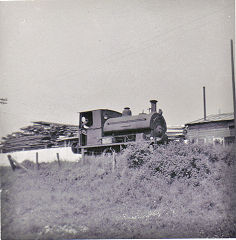
The photo was taken in 1966 at the north end of the works showing Peckett 2146, built in 1953.
A footpath runs between what were the two sections of the works and leads to the original NAHR station building, derelict but still standing and an unusual footbridge
over the Hereford line.
|
Back to the top
PONTYPOOL and PONTYMOILE
Pontymoile
|
There are three aqueducts at Pontymoile, the centre one is the course of the Afon Llwyd, the Western one was the route of the Pontypool Tramway
and the Eastern one less obvious. It is certainly a footpath now but was it also a tramway route? The outside tubes are probably flood tunnels but the shape of the
middle 'tube' suggests a horse tramway. There is no evidence of this on the old maps but.... The Western aqueduct has two tunnels, the Western one probably a watercouse
and the Eastern one carried the tramway from the Lower Mills tinplate works to Pontypool town. All three aqueducts are in excellent condition.
|
Pontypool Town
|
The tramway from Pontymoile can be traced up the lane from the canal, across Usk Road and past Pontymoile tinplate works, where an old building is used by a builders merchant.
The tramway carries along the riverbank through the leisure centre car park. Here a branch went to the old Pontypool gasworks at ST 284005, which was in use by 1885.
At ST 283008, the tramway passed through a tunnel, constructed c1825, under the town centre. The tunnel is partially open as it contains pipework for one of the services.
There are openings to the right onto the steep riverbank and then it is blocked up. It is untraceable beyond here as it carried on along the riverbank to Town, Central and
Osborne Forges. Modern housing and roads have obliterated the area but in places the Western river banks and walls show their age and heritage.
|
Back to the top
CWM-FFRWD-OER
Plas-y-coed
|
Plas-y-coed Brickworks and Eastern Valleys Black Vein Colliery shared the site immediately beside the viaduct at SO 262013. Little remains now but rough ground.
Plas-y-coed Colliery was 0.5 miles further west at SO 258010 and was open from 1885 to 1923. Not much remains but there is an adit entrance still visible.
There are the remains of two small adits on the left hand side of the road at SO 258009, one appears to be stone and the other metal arched.
These are just before the long, thin quarry SO 256006.
There were other levels in the area including three comprising Plum Tree (or Cwmfrydoer) Colliery, open from before 1886 to at least 1908.
These may have been on the other side of the valley.
|
Tirpentws and Ty Gwyn
Tirpentws Colliery (originally known as Gelli) was the largest in Cwm-ffrwd-oer at SO 247999, working from 1868 to 1969 and included a small level known as Black Vein.
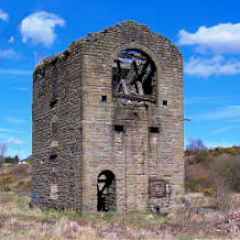
After closure the whole area was cleared, used as a rubbish dump and now landscaped. There are the remains of a large building at SO 246000 beside a small quarry.
A 2'8" gauge tramway ran from the colliery to a landsale yard at SO 255005 from 1901 to1919.
Ty Gwyn Colliery overlooked Tirpentws from the Western head of the valley at SO 242002.
There are overgrown tips at the head of the track down to Tirpentws and the site of a shaft at SO 241000.
|
The Canyons area
Black Barn Colliery was a rarity in South Wales, a working small mine, situated at SO 241007. There are two adits, the upcast occupied by the conveyor system, the downcast by
the tramway leading to an ingenious tippler that tips the whole tram. Unfortunately, in 2009, production ceased and most of the equipment was moved elsewhere.
Blaen-y-cwm Colliery was an old mine working from before 1843 to around 1895. There are still some old tips to be seen but the working area has disappeared under the
opencast and forestry work.
Hafodyrynys Canyons were formed by NCB opencast work begun in the 1950s and closed down in the 1960s. They are now partially flooded and forested. An aerial ropeway ran from
the Eastern end across the hill to Blaenserchan in Cwm-nant-ddu valley and the concrete loading bases remain. The disused canyons also became the home to two small mines.
The sites are difficult to spot in amongst the general dereliction but there are still signs of them about.
Pant-y-gasseg Colliery in the Eastern canyon (SO 239014) opened in 1972, closing in 2005 and reputedly the last horse-worked mine in South Wales.
The two adits have been sealed but odd rails can be found. A newer adit to the left and in front of the other two is quite prominent.
Ruthin Colliery in the Western canyon (SO 234015) opened at around the same time but was closed by 1995.
|
Back to the top
GLYN VALLEY
Southern Side
| Glyn Quarry |
ST 2578 9946 |
Glyn Quarry, also known as 'Blaendare Quarry' after its owners, is shown on the 1880 OS map but had closed by 1912.
The large, steep-sided quarry is very rough but the internal tramways are traceable from the quarry floor as far as the lost incline top.
|
| Quarry Level |
ST 2578 9951 |
The Quarry Level, or Wern Tillery Colliery, is shown on the 1880 OS map just below the quarry but has disappeared by 1901.
With the closure of the quarry, the Blaendare Co re-open it c1912, becoming infamous in 1926 when a strike is broken by a police baton charge. Quarry Level closed around 1943.
The return adit is gated and once had a furnace flue just above it, where foundations and a large diameter iron pipe remain. The main adit was dug into the top of the quarry incline
and has been sealed. An emergency exit from the mine is reported to emerge near Blaendare Farm. The remaining part of the quarry incline connected the mine with the Blaendare
branch. About halfway down on the left are the foundations of the stables and blacksmith's. Here, the incline cuts through the ancient leat to Glyn Pits which, on the right, was
carried on a sustantial stone-built causeway, now heavily overgrown.
|
| Glyn Level No. 2 |
ST 2539 9938 |
Glyn Level No.2 opened prior to 1880 and was disused by 1920, being retained for ventilation as it had a small furnace
(really just a large fireplace) situated inside the entrance. |
Glyntillery Colliery (circa 1913), Glyn Level No. 1 (1880) |
ST 2522 9930 |
The first incarnation of Glyntillery Colliery, opened as Glyn Level No.1 prior to 1880 and renamed Glyntillery around 1913.
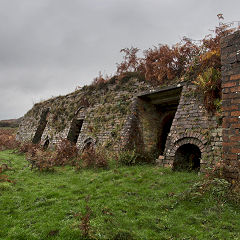
It was disused by the 1960s. The woods conceal a number of interesting remains - brickwork and the sealed adit and drainage adit, foundations, old rails and the body of a
metal dram (or could it just be a watertank?). What appears to be the ironwork of a wooden-bodied dram a nd a flue lie close by. |
Glyntillery Colliery (Post-1920) |
ST 2470 9915 |
The second incarnation of Glyntillery Colliery, disused by the 1960s on the opening of the third site. A second adit is shown
just below the Blaendare branch and another adit a little further to the east at ST 2493 9925. The site of the sidings and tips beside the Blaendare branch are clear as is the
site of the main adit and a number of collapses behind it. |
| Glyntillery Colliery (1954) |
ST 2387 9869 |
The third and final incarnation of Glyntillery Colliery, previously one of Hafodyrynys Colliery's drifts. The drift
was closed in 1975 finally ending the nomadic existence of Glyntillery Colliery.
|
| Hafodyrynys Colliery |
ST 2437 9902 |
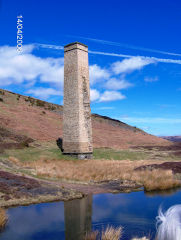
The surviving water tower of the once extensive site of the modern Hafodyrynys Colliery, opened by 1914.
A modernisation scheme in the 1950s saw new drift mines either side of the valley but coal-winding ceased in the 1960s. However, the washery continued in use until the 1970s.
The filled-in concrete portal of the 1954 level is to the North of the main road.
|
Northern Side
| Coedcae Newydd Colliery |
SO 2598 0007 |
This colliery appears only on the 1920 OS map and the tramway, tips and sites of numerous adits along the
outcrop survive in deep and vicious undergrowth. Owned by John Bowen in 1904 but he went bankrupt in 1905 according to the London Gazette. Not a good businessman or
not good coal?
|
| Cwm Glyn level |
ST 2579 9988 |
A stone wall on the side of the Old Crumlin Road is the only obvious sign of Cwm Glyn level, abandoned in 1878,
but there's evidence of later workings running NW to a cutting in the hillside.
|
Back to the top
Photo Gallery
Many more photos of the Abersychan area are in the photo galleries :-
and specific galleries for the area are :-
From Griffithstown to Pontnewynydd - The Pontypool Gallery
Blaendare, Cwm Lickey and the Races - The Blaendare and the Races Gallery
The Glyn Valley to Hafodyrynys - The Glyn Valley Gallery
The Cwm-ffrwd-oer valley to the canyons - The Cwm-ffrwd-oer Gallery
The Cwm-nant-ddu Valley to Blaenserchan - The Cwm-nant-ddu gallery
Other Locations
A comprehensive sortable 'Excel' spreadsheet of all known sites can be downloaded here :- The Industrial Archaeology of Monmouthshire
Back to the top
|
|
|