|
Henllys and Oakfield at 'Industrial Monmouthshire - The Leftovers'
Oakfield Wireworks, Llandowlais and Ty Coch Brickworks and Henllys Colliery
Click on a photo to enlarge it but if there are no return links available, please use the 'back' button on your browser to return to this page.
Oakfield and its surrounding area was home to a fascinating group of inter-connecting industries that used tramways, inclines, railways and
the canal for transport. They included brickworks, ironworks, collieries and quarries.
Click on the link to go to the brickworks, the incline, Henllys Colliery.
|
OAKFIELD WIREWORKS and RAILWAY

Oakfield, general area from www.ordnancesurvey.co.uk
|

Oakfield Wireworks, 1901 from www.old-maps.co.uk
|
The hub of the system situated at the heart of Oakfield village, owned by Whitehead, Hill and Co Ltd from 1925. The wireworks was opened in 1857 by J.C.Hill with connections to both
the MRCC's canal and railway. The railway link closed in December 1966 when the contract to supply coal to the white brickworks ended. The works passed to BSC in 1968 and closed in
1971. The railway system connected to the MRCC just south of Cwmbran goods yard, opposite the Vitriol Works. From the internal system, one spur crossed Hill Street to a wharf on the
canal and the other left the wireworks by a fine set of iron gates, crossed Llandowlais Street and immediately forked to the red and white brickworks. The site is now the TA
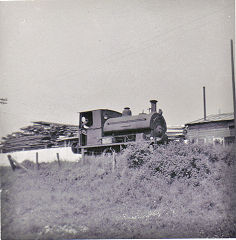
Headquarters and a small industrial estate. The railway system was operated by three 0-4-0 saddletank locos, named 'Perseverance', 'Whitehead' and 'Hill' (IRS Gwent).
'Perseverance' was purchased new from Manning, Wardle & Co of Leeds (Works No. 675) in 1877 and worked until 1925 when it went off to Moderator Wharf, Newport, soldiering on
there until 1950.
'Hill' came secondhand from Hayle, Cornwall, in 1924, displacing 'Perseverance'. It was built in 1917 by Peckett & Co of Bristol (Works No. 1448) and was latterly used to keep
'Whitehead' running, finally being scrapped when the line closed. In June 1966 it was partially dismantled in the engineering shops of the wireworks.
'Whitehead' arrived in 1936 or 1937 from Berthlwyd Colliery, Swansea, another but older Peckett dating from 1908 (Works No. 1163). Despite being the elder sister it ran the line
until the end usually taking a single wagon of coal across the canal to the 'white' brickworks, which had very difficult road access. Luckily 'Whitehead' is preserved and can usually
to be found at the Midland railway Centre, Butterley, Derbyshire but has returned to the area as a guest at the Pontypool and Blaenavon Railway.
Either loco was always referred to as 'Puffing Billy' when being watched avidly through the iron fence round the brickworks by a certain small boy! By the time he was old enough to
trainspot properly, he was very disappointed to not find them listed in his Western region 'ABC'.
|
| Oakfield Wireworks |
ST 2925 9430 |
Now the TA Headquarters, interesting military hardware, but nothing left of the wireworks. Modern Ty Coch Way roughly follows the original Hill Street and
the Western wall of the works yard. The level crossing and junction to the two brickworks are more or less under the roundabout. Cwmbran Drive follows the course of the
Monmouthshire Railway and the end of Abbey Road is where the wireworks railway joined the MRCC line. |
| Electricity Sub-station |
ST 2918 9430 |
This modern pre-fab unit sits on the original site of the brick-built version which was inset into the Wireworks wall. I seem to remember it being inscribed
'Cwmbran Urban District Council 1937'. The siding to the canal wharf crossed the road at the end of the industrial units opposite. |
| Alfa-Laval factory |
ST 2935 9410 |
Built about the same time as Llandowlais brickworks, Alfa-Laval made milking machines and similar agricultural equipment. The photo below shows the factory
as the construction of Cwmbran Drive was underway. The factory was closed and demolished later on. |
| Printpac factory |
ST 2925 9413 |
This was also part of Alfa-Laval's site but latterly is Printpac. The line to the Llandowlais brickworks ran along the outside wall of the front carpark.
|
|
Some of the historic photos come from other local websites - Cwmbran Info and D C Hopkins.
Please have a look at them, they've many more photos of Monmouthshire, but both seem to be under the threat of closure. Let's hope they don't get lost somewhere in cyberspace.....
|

"Whitehead" about to cross the canal bridge, 1966
|

"Whitehead between the bridge and Llandowlais Street, 1966
|

"Whitehead between the bridge and Llandowlais Street, 1966
|

"Whitehead" about to cross Llandowlais Street, 1966
|

"Whitehead" at the Abbey Road MRCC Junction, 1966
|

"Whitehead" at the Abbey Road MRCC Junction, 1966
|

Llandowlais Street with the wireworks in the distance. from 'www.cwmbran.info'.
|

Llandowlais Street and Hill Street with wireworks on the right, c1970. from 'www.cwmbran.info'.
|

Llandowlais Street with the wireworks in the distance. from 'www.cwmbran.info'.
|

Llandowlais Street and Hill Street with wireworks on the right, c1970. from 'www.cwmbran.info'.
|

Llandowlais Street with the wireworks on the right. from 'www.cwmbran.info'.
|

"Whitehead" in the wireworks. from 'www.cwmbran.info'.
|

"Whitehead" crossing Llandowlais Street, 1966 from 'South Wales Argus'.
|

"The Alfa-Laval factory, Llandowlais Street, c1970 from 'www.cwmbran.info'.
|
|
|

The railway bridge over the canal. from 'www.cwmbran.info'.
|

The railway bridge over the canal. from 'www.cwmbran.info'.
|

Two locks canal bridge abutment, 2005
|
|
Back to the top
THE BRICKWORKS
|
The 'white' brickworks, Ty Coch
The original brickworks at Ty-coch specializing in refractory or fire bricks, dated from before 1840 and is now a housing estate. The site was originally the canal
basin at the lower end of the incline from Henllys Colliery, probably dating from around 1814. It was described as a 'coalworks' and owned by Joshua Hanson in 1840,
the six bottle-shaped kilns of the 'firebrick' works being opened in 1842/43 by Joshua's son Cyrus. It seems one of the kilns had collapsed by 1882 but not replaced.
Rail traffic carried on until 1966, a lot to do with the road entrance being a narrow lane of Two Locks Road.
The 'red' brickworks, Llandowlais
A 'new' brickworks making ordinary house bricks, hence the 'red', opened shortly after the second world war, c1950, at Llandowlais. It quarried its clay from claypits to the south of
the works, east of Ty-coch Lane and the canal. A trial pit was dug on the west side of Ty-coch Lane in the early 1960s, reached by a concrete culvert over the canal, but not
developed. The red brickworks was disused by 1966, the sidings containing one solitary empty boxvan, and probably closed when the railway closed at the end of the year. The brickworks
site is now occupied by the Ty-coch Industrial Estate.
In the late 1800s a very small brickworks existed on the other side of Ty Coch Lane just below the canal lock but it was gone by 1901.
|
| 'Red' brickworks and branchline |
ST 2923 9409 |
The Llandowlais Brickworks branch ran alongside the South-Western wall of the 'Printpac' factory carpark. The red brickworks itself lies under the
ex-Ferranti factory on the Ty-coch Industrial Estate. Its clay pits have been levelled and are now offices and housing. There is nothing to use as a reference point. |
| 'White' brickworks branchline |
ST 2914 9412 |
The branch to the 'white' brickworks went from the roundabout to the right behind the 'Waterloo' pub and the builders / timber yard, the trackbed can just
be made out as far as the site of the canal bridge.
|
| Canal bridge abutment |
ST 2909 9409 |
The one surviving abutment of the canal girder bridge is a very small reminder of past glories. Beyond the bridge a housing estate occupies the site of the
white brickworks and there are no reference points. |
| Lime kilns |
ST 2873 9395 |
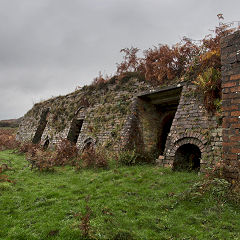
This restored pair of early 19th c. limekilns were right behind the 'red' brickworks site. |
Trial claypits and canal bridge |
ST 2899 9377 ST 2901 9380 |
The trial pit was dug in the 1960s and the low concrete canal bridge gave access to Llandowlais Brickworks. The pit is now a kiddies playground. |

White brickworks as it was.....
|

Ty Coch 'white' Brickworks, 1901 from www.old-maps.co.uk
|

Llandowlais 'red' Brickworks, 1965 from www.old-maps.co.uk
|

Bowkett's lorry leaving the white brickworks, 1971. from 'www.cwmbran.info'.
|

The "white" brickworks, Ty Coch. from 'www.cwmbran.info'.
|

The "white" brickworks, Ty Coch, 1988. from 'www.dchopkins.co.uk'.
|

The "white" brickworks, Ty Coch, 1988. from 'www.dchopkins.co.uk'.
|
|
Back to the top
THE INCLINE
The Incline began at the 'white' brickworks canal basin and ran for around two miles to Henllys Colliery, rising over 600ft (210m) in the process.
There were two main sections to the incline plus an extension to the large upper quarry. The main section rose steadily, running virtually due West, from the end of the
brickworks yard to Machine Cottage. Machine Cottage stood beside the head of the main incline and the weighing machine, from which it took its' name, and
Incline Terrace just below it included a shop. The upper section carried on steeply to the colliery. From there the third section ran up to the large quarry.
There also appears to be a short incline up to the small upper quarry, coming off the tramway from the colliery yard to the upcast shaft.
Lawrence Skuse found the two chairs pictured below and says "The Henllys tramway "chairs" were found at two different parts of the Henllys Incline (one Lower, the other Upper). As you
can see, one still has the bolt which attached it to the stone slab "sleeper", the other not. One is also slightly larger than the other; whether this is because they had slightly
different loads due to differing steepness of the incline along its route, or just that from 1815-1927, different patterns were bought in over the period I can't say; the latter I
suspect." (ci)
|
| Course of lower tramway |
ST 2857 9407 |
From the Hollybush roundabout, looking back towards the brickworks, the tramway from the colliery followed the access lane to the house and garage.
looking towards the colliery the tramway crossed the road and passed behind the Mill Tavern to cross Coed Eva Lane. From here on the route up to Incline Terrace and Machine
Cottage is a modern public footpath. The passing loop would have been just below Penylan Way. |
| Ced Eva Corn Mill |
ST 2841 9403 |
The Mill is a private house but I'm told that remains of the waterwheel still exist on the property. |
| Bottom of lower incline |
ST 2825 9413 |
The lower incline ended here, beside the stables for the horses that worked the brickworks area. |
| Overbridge abutments |
ST 2681 9414 |
Restored overbridge abutments on course of old lane but not shown on OS maps. |
Machine Cottage and Incline Terrace |
ST 2669 9415 |
The head of the lower incline. Machine Cottage was the weigh station and Incline Terrace contained a shop,
probably served beer too!. |
| Upper incline to lane |
ST 2655 9418 |
If you take the footpath beside Machine Cottage and cross the stile to your left, you'll find the incline runs on a low embankment along the edge of the
field behind 'Four Houses'. A stile at the top brings you out onto 'Craig Llywarch Lane'. |
| Bridge abutment |
ST 2640 9423 |
The incline crossed 'Craig Llywarch Lane' by a bridge and the abutment has been rebuilt to carry the footpath up the hillside. |
| Upper incline to colliery |
ST 2625 9429 |
The incline continues steeply up to the colliery with possible stone sleepers visible. |

The incline as it was....
|

Overbridge near Machine Cottage, 2007
|

"Machine Cottage", 2007
|

Incline at Llywarch Lane, 2007
|

Incline below colliery, 2005
|

Lawrence Skuse' incline chairs from 'www.cwmbran.info'.
|

Lawrence Skuse' incline chairs from 'www.cwmbran.info'.
|
|
Back to the top
HENLLYS COLLIERY
This was the closest Eastern Valley colliery to Newport, at 900ft (300m) high on the hillside above Cwmbran. Joshua Hanson opened it in c1814 along with the incline and tramway down
to the canal basin and brickworks at Ty-coch. Around 1878 the colliery changed hands, passing to J C Hill of the Oakfield Wireworks, later 'Whitehead, Hill & Co'. The colliery
came under the ownership of 'The Patent Nut and Bolt Co' of Cwmbran, later GKN Ltd, by 1896 when 67 men were employed, 51 underground and 16 on the surface, one of whom was my
Grandfather. They were raising around 30,000 tons of coal per year. Employment had dropped to just 10 men in 1901 but was back up to 139
by 1911. Both colliery and incline closed
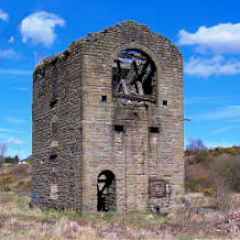
around 1926 as being unrenumerative. Sadly five men lost their lives during the colliery's working life (RL). The ruins of the engine house, other buildings and open adit were still
there in 1959-60 when I first visited it, the adit being full of tiny frogs!
The main colliery consisted of the main or downcast adit, three quarries, two reservoirs, a drainage or water level, a double limekiln and a small row of cottages. The quarries
supplied the stone for the Ebenezer Chapel of 1860 at Two Locks. In June 1970 the whole area around the adit was bulldozed and filled with weathered shale (RL).
The upcast shaft was about 1/2 mile to the north, around 15ft diameter and 370ft deep, connected to the main area by a tramway. It doesn't appear on the 1882 OS map but is shown on
the 1901 version. Certainly the remaining foundations appear more modern, being a mix of Stone, brick and concrete. The ventilating fan from Cwmbran Mineslope came here in 1916 (wcm).
A drainage level was driven through the hillside to the Nant Carn valley, shown as a coal level with an airshaft just above it in 1880 but 'old' in 1901. In 1952 a borehole was
driven from Cwmcarn Colliery into the old Henllys and Cwmbran workings to relieve the build-up of water pressure.
There were also four small levels about 1/2 mile to the South, above Blaen-y-cwm Farm. They don't appear on the 1901 OS map but one is shown as 'old' in 1920 and three others as
'disused' by 1962.
|
| Colliery tips |
ST 2600 9437 |
The incline runs between the tips of the colliery. Just below the tips the course of the tramway round to the old level goes off to the right. |
| Site of main adit |
ST 2588 9441 |
Sadly the whole of the colliery site and reservoirs has been cleared, levelled and filled. A mound of rubble as the
incline levels off marks the
approximate site of the main adit. |
| Limekilns, level and cottages |
ST 2606 9446 |
Following the course of the tramway below the tips brings you first to the foundations of some buildings, including those of Kiln Cottages, later known as
Tip Terrace. The rather wet approach to the old level, looks more like stream now, is on the right and the rather ruined limekilns just behind it. |
| Colliery Quarry and drainage adit |
ST 2600 9449 |
The Colliery quarry has a drainage adit in the centre of the face, the dribbling water has stained the quarry wall quite orange.. |
Incline and large quarry |
ST 2572 9442 ST 2563 9443 |
The route of the incline is obvious once it leaves the colliery precincts as it runs up the hillside to the large quarry. |
| Spring (old level) |
ST 2575 9458 |
A small sealed stone-arched water source with a cast-iron pipe leading downhill towards the lower reservoir but seems unlikely to have been a level,
it's only about 2ft x 3ft.... |
| Tramway to upcast shaft |
ST 2588 9463 |
The route of the tramway from the main adit to the upcast shaft. On the left used to be an airshaft in 1882, now just a slight depression. |
| Small quarry |
ST 2576 9468 |
The small quarry and incline to upcast tramway. Look for the stonework where the incline crosses the track. |
| Upper reservoir |
ST 2595 9493 |
The upper reservoir, divided into two sections with the outlet sluice. The leat leads to the stonework on the small quarry incline and, I guess, from
there to the large reservoir. |
| Upcast shaft and ruins |
ST 2607 9506 |
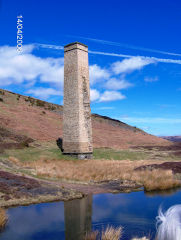
Ruins, tips, foundations, ironmongery and the 15ft upcast shaft are all around you. |
| Quarry workings |
ST 2601 9513 |
Some minor workings here appear to be connected to the small quarry by a leat or track. |
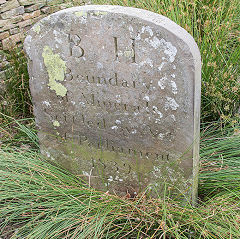
| Boundary stones |
ST 2509 9518 |
The original, rather overgrown track (not the current one) up the hillside to the ridge is lined by boundary stones. |
| levels to the South-East |
ST 2544 9383 |
Four small levels and their tips here are the Southern-most coalworkings in the Eastern Valleys. |
| Cwmcarn drainage adit |
ST 2495 9460 |
A well-built stone drainage adit sits beside the Cwmcarn Scenic Drive issuing very rusty coloured water into the Nant Carn. If you drive here, you'll have
to pay! |

Henllys Colliery, general area from www.ordnancesurvey.co.uk
|

Henllys Colliery main level, 1901 from www.old-maps.co.uk
|

Henllys Colliery upcast shaft, 1920 from www.old-maps.co.uk
|

The colliery as it was...
|

Henllys Colliery engine house, believed c1950
|

Henllys Colliery lower reservoir, c1950
|

Henllys Colliery main adit, 2007
|

Henllys Colliery upcast shaft, 2005
|

Henllys Colliery upcast shaft, 2010
|
|
|
|
Back to the top
Photo Gallery
Many more photos of the Henllys and Oakfield area are in the photo galleries :-
Henllys, Ty Coch and Oakfield - The Henllys and Oakfield Gallery.
Other Locations
A comprehensive sortable 'Excel' spreadsheet of all known sites can be downloaded here :- The Industrial Archaeology of Monmouthshire
Back to the top
|
|
|